Is Your Moisturizer a Personality Now? The Luxury Skincare Status Game, Fully Examined
There is a very specific cultural phenomenon that occurs when someone mentions their skincare routine at a dinner party. A certain kind of person — and you know this person, you may be this person — will pause before naming their products. Not because they've forgotten what they use. Because they are doing a quick mental calculation about whether the brands they're about to name will land correctly.
This is what happens when skincare becomes a status signal. And make no mistake: it absolutely has.
The Moment Moisturizer Became a Mood Board
Luxury skincare has existed forever — La Mer has been charging extraordinary amounts of money for face cream since 1965, and Crème de la Mer has been the punchline and the aspiration in equal measure ever since. But something shifted in the mid-2010s with the rise of a new category: the "indie luxury" brand. These were not the old-guard department store counters with their white lab coats and gift-with-purchase mascara. These were brands that looked like they'd been designed by someone who also owns very expensive candles and knows where to get good sourdough.
The packaging was minimalist. The color palette was neutrals. The brand story was always some version of "founded by a person who was frustrated with what was already out there and decided to do it better." The prices were significant. The followers were devoted.
Drunk Elephant became perhaps the most visible example of this archetype — a brand built on a philosophy of avoiding what it called the "Suspicious 6" ingredients, wrapped in cheerful, colorful packaging that photographed beautifully and retailed at prices that made drugstore shoppers quietly sweat. A face oil in their lineup will run you $40 and up. A vitamin C serum is over $90. The brand sold to Shiseido in 2019 for $845 million, which is a number worth sitting with for a moment.
Let's Actually Look at the Ingredients
Here is the part that cosmetic chemists find professionally entertaining and consumers find deeply inconvenient: the ingredients in premium skincare products are, with some notable exceptions, not proprietary. The same actives — retinol, hyaluronic acid, niacinamide, vitamin C derivatives, peptides — appear across price points from $8 to $280. What varies is the concentration, the formulation quality, the stability of the active ingredients, and the elegance of the texture.
Those last factors are real and they matter to varying degrees. A poorly formulated vitamin C serum that oxidizes in three weeks is not a bargain at any price. Texture and sensorial experience affect compliance — if you love how a product feels, you'll actually use it, which makes it more effective than the technically superior product you leave on the shelf because it smells medicinal.
But — and this is a substantial but — the markup from a functional drugstore formula to a luxury one is rarely justified by formulation alone. Cosmetic chemist and industry commentator Perry Romanowski, who has written extensively on this topic, has noted repeatedly that the manufacturing cost of even a premium skincare product is typically a small fraction of the retail price. The rest is packaging, marketing, retail margins, and what economists would politely call "perceived value."
In less polite terms: you are paying for the feeling of buying it.
The 'Clean' Halo and the Philosophy Markup
One of the cleverest things the indie luxury skincare movement did was attach a philosophy to the product. It wasn't enough to sell you a good moisturizer. The moisturizer had to represent a stance. On ingredients. On transparency. On what it means to truly care for your skin versus just slapping any old thing on your face like some kind of animal.
This philosophy markup is real and quantifiable. Research on consumer behavior consistently shows that people will pay significantly more for a product when they believe it aligns with their values — whether that's "clean," "sustainable," "non-toxic," or "founded by someone who genuinely cares." The fact that these claims are often loosely defined or inconsistently regulated is somewhat beside the point. The feeling of alignment is what's being purchased.
Casey Winters, a 34-year-old graphic designer in Portland, Oregon, describes her relationship with a beloved luxury brand with the slightly sheepish honesty of someone who has thought about this more than she expected to. "I know I'm probably paying for the packaging and the vibe. I've read enough about ingredients to know my $12 niacinamide serum is doing the same thing as the $68 one. But I keep buying the $68 one because it makes me feel like I'm taking care of myself properly. Like I'm the kind of person who invests in her skin." She shrugs. "Is that dumb? Maybe. But it works on me."
That's not dumb, actually. That's remarkably clear-eyed self-awareness about a psychological mechanism that is both completely understandable and exactly what these brands are counting on.
The Shelfie as Social Currency
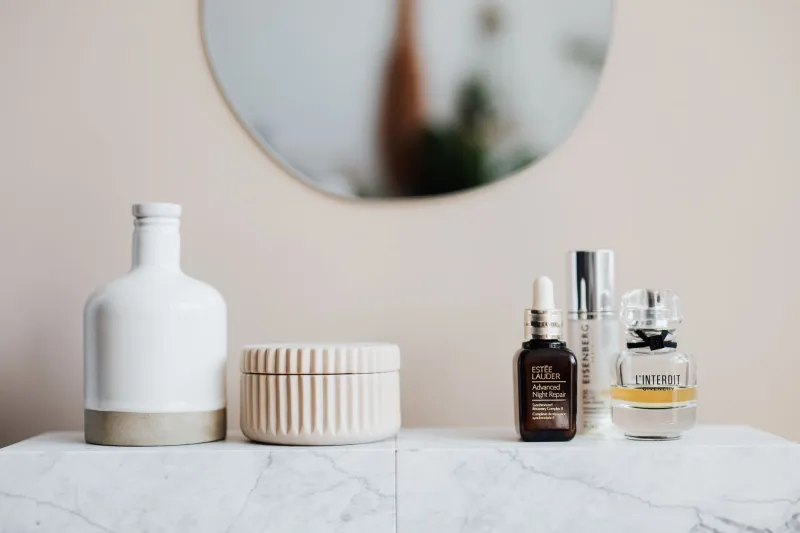
Instagram and TikTok did something genuinely novel to skincare: they made the products themselves into content. The "shelfie" — an artfully arranged photograph of one's skincare collection — became a genre. And within that genre, brand recognition matters enormously. A shelf full of recognizable luxury bottles signals not just that you care about your skin, but that you have the resources and the taste to care about it correctly.
This created a new purchase motivation that has nothing to do with efficacy: social legibility. Buying a brand that your audience will recognize and approve of. This is not new human behavior — conspicuous consumption has been documented since Thorstein Veblen was writing about it in 1899 — but the speed and scale at which beauty brands can now build recognizable visual identities and convert them into social currency is genuinely new.
The cheerful, brightly colored packaging of certain brands isn't accidental. It's engineered to be recognizable in a thumbnail. That's a design decision with a direct line to your purchasing behavior, and it's worth knowing about.
What You're Actually Buying
None of this is to say that luxury skincare is a scam in any simple sense. Some premium formulations genuinely are more stable, more elegantly textured, or more carefully developed than their budget counterparts. Paying more for a product you'll actually use consistently is not irrational. And if a beautiful bottle on your bathroom counter makes your morning routine feel like a small act of self-care rather than a chore, that psychological benefit has real value.
But it's worth being honest about what portion of your $90 serum purchase is buying you better skin versus buying you membership in a particular cultural tribe. The serum does something. The brand does something different. Both are real. Only one of them is in the ingredient list.
The next time you're standing in Sephora doing the mental calculation between the $14 option and the $74 option with nearly identical active ingredients, ask yourself one honest question: am I buying skincare, or am I buying the right to feel smug about my skincare?
Either answer is valid. Just know which one you're paying for.