Wide-Eyed and Wallet-Empty: The Lash Extension Trap Nobody Warned You About
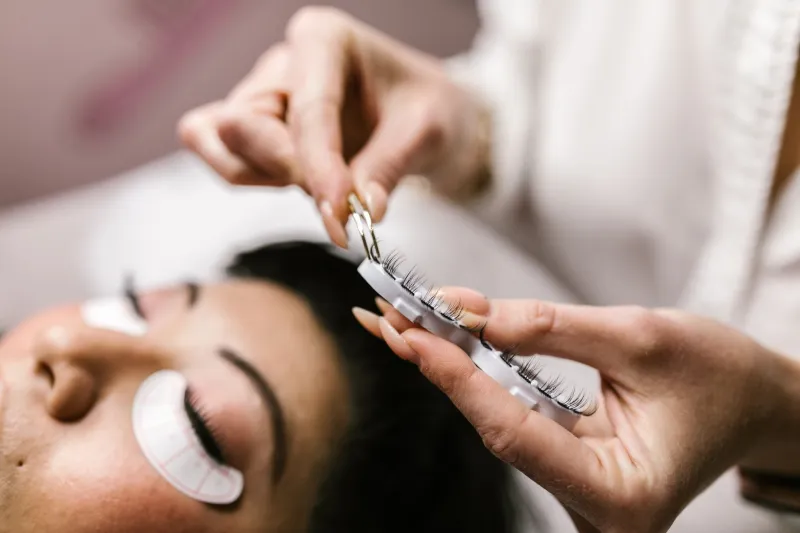
The promise is seductive in its simplicity: wake up looking like you're already camera-ready, no mascara wand required, no raccoon eyes by 3 p.m. Just long, full, perfectly curled lashes, every single morning, indefinitely.
The reality is a bit more complicated, and considerably more expensive, and involves a surprising amount of crying — which, it turns out, is very bad for the extensions.
How We Got Here
Lash extensions have been a fixture in the professional beauty world for decades, but they went genuinely mainstream in the US somewhere around 2015, riding the wave of Instagram's ascent and the broader cultural obsession with looking "done" while appearing effortless. By the early 2020s, lash studios had proliferated in every strip mall in America, competing on price and speed with the same energy as fast food franchises.
The industry is now worth an estimated $1.5 billion in the US, which is a lot of money for something that is, at its core, gluing synthetic fibers to your face.
That's not a knock — plenty of beauty rituals involve adhesive and ambition. But the scale of the lash extension industry, and the opacity around how it actually works, warrants a closer look.
The Training Question Nobody at the Studio Wants to Answer
Here's an uncomfortable fact that the glossy Instagram presence of your local lash studio would prefer you not dwell on: lash extension technician training requirements vary wildly by state, and in some states, the bar is genuinely low.
In the US, lash extension services are regulated differently depending on where you live. Some states require technicians to hold a full cosmetology or esthetics license. Others allow certification through private training programs that can be completed in as little as two days. Two days. To work in close proximity to someone's eyeballs with adhesive.
Licensed esthetician and lash educator Tanya Briggs, who trains technicians in the Pacific Northwest, is candid about the problem. "I've seen people complete a weekend course and open a studio the following week. That's not enough time to understand lash mapping, isolation technique, or how to recognize when a client is having an allergic reaction to the adhesive." She pauses for emphasis. "The eyes are not the place to practice."
Cyanoacrylate — the primary adhesive used in most lash extensions — is a powerful bonding agent. In skilled hands, applied correctly, it stays on the lash and nowhere else. Applied incorrectly, it can bond to the eyelid, cause chemical burns, or trigger contact dermatitis. Reactions range from mild irritation to significant swelling. And because the beauty industry runs largely on vibes and Yelp reviews rather than rigorous oversight, the chances of encountering a technician who learned everything they know from a YouTube playlist are not zero.
The Actual Damage Report
Let's talk about what happens to your real lashes, because this is where the story gets genuinely grim.
Natural lashes have a growth cycle of approximately 60 to 90 days. Extensions are attached to existing lashes, which means when those lashes shed naturally, the extension goes with them. The problem arises when extensions are applied incorrectly — too heavy for the natural lash, or bonded to multiple lashes at once — creating tension that disrupts the follicle and, over time, damages lash density.
Dr. Rachel Stein, a board-certified dermatologist in Los Angeles who sees a steady stream of lash-related consultations, describes the condition with a clinical term that sounds much worse than it already is: traction alopecia. "It's the same mechanism as damage from tight hairstyles. Sustained tension on the hair follicle can cause permanent loss of lash density. I see patients who've been getting extensions for two, three years and are alarmed by how sparse their natural lashes have become. In some cases, the damage is reversible with time. In others, the follicle is genuinely compromised."
She's careful to note that this isn't an inevitable outcome — properly applied extensions, on an appropriate lash weight for the natural hair, with adequate breaks between sets, can be worn without significant damage. The operative words there are properly applied, which brings us back to the training question.
The Maintenance Trap Is the Real Business Model
Here's where the economics become truly impressive in a way that should make you sit down before reading.
A full set of lash extensions at a mid-range studio in most US cities runs between $150 and $250. Fine. You pay it, you look fabulous, you feel like a person who has their life together. But extensions require fills every two to three weeks as your natural lashes shed and gaps appear. Fills typically run $65 to $100. Do the math: a fill every two and a half weeks at $80 is approximately $1,664 per year. On the high end of fills, you're approaching $2,600 annually. For lashes.
Jessica Park, a 28-year-old nurse in Nashville, got her first set three years ago and describes the financial drift with the weary clarity of someone who has already done this math. "It starts as a treat. Then you get a fill because you don't want to lose the set. Then you can't imagine going back to your natural lashes because they look so sad by comparison. I calculated what I spent last year and it was over $2,000. I could have taken a vacation. I could have taken two vacations."
This is, of course, by design. The lash extension model is a subscription business dressed up as a beauty service. The initial set creates a dependency — not through any manipulation, just through the simple reality that your natural lashes look noticeably different once you've been wearing extensions for months. The fill keeps you coming back. The math keeps you trapped.
The Break-Up Is Also Expensive
Deciding to quit lash extensions is, annoyingly, not free either. Professional removal runs $50 to $100. Attempting DIY removal with oil-based products risks taking your natural lashes with it. And then there's the transition period — the weeks or months during which your natural lashes, whatever their current state, have to grow back in while you walk around looking like you've had a very long year.
Many salons will gently suggest lash serums during this period. Lash serums, of course, cost money. The ecosystem is remarkably self-sustaining.
So... Should You Get Them?
Look, we're not here to tell anyone what to do with their face. Extensions, done well by a properly trained technician, can be genuinely beautiful and relatively low-maintenance in the short term. If that's your thing, we support your right to look perpetually surprised by life's events.
But go in with eyes open — which, with a fresh set, they will be, because blinking is briefly weird. Ask your technician about their training and licensing. Ask what adhesive they use and whether they test for sensitivities. Take breaks between sets. And maybe — just maybe — run the annual number before you commit to the subscription.