Sun-Kissed or Sun-Scorched? The Bronzer Industry Has Been Playing Us for Years
Let's set the scene. You're standing in your bathroom, ring light blazing, freshly watched a 47-second tutorial from someone whose cheekbones appear to have been sculpted by a Renaissance master with a grudge. You pick up your bronzer brush, swirl it with confidence, and apply. You look radiant. You look warm. You look like you spent the weekend on a sailboat somewhere off the coast of Cape Cod.
Then you walk outside.
Suddenly, in the unforgiving fluorescent light of a Walgreens parking lot, you look less "effortless summer glow" and more "someone who lost a fight with a self-tanner at a county fair." The line where your bronzer ends and your neck begins has become a geological feature. Your forehead is a different timezone from your chin. You are, by every observable metric, a two-toned human being.
This is the Bronzer Paradox, and it has claimed more victims than any beauty trend since the frosted lip.
The Studio Problem Nobody Talks About
Here's the dirty little secret the beauty industry would prefer you not examine too closely: the bronzer looks you've been chasing were never designed for your face. They were designed for a camera sensor.
Editorial makeup — the kind you see in magazine spreads and campaign shoots — is built for controlled studio lighting that flattens everything and a post-production team that will cheerfully remove any evidence of a heavy hand. When a makeup artist loads up a model's cheekbones with three shades of bronzer and a highlighter that could signal aircraft, it photographs as a subtle, dimensional warmth. In real life, that same application would have you being gently pulled aside by a concerned friend.
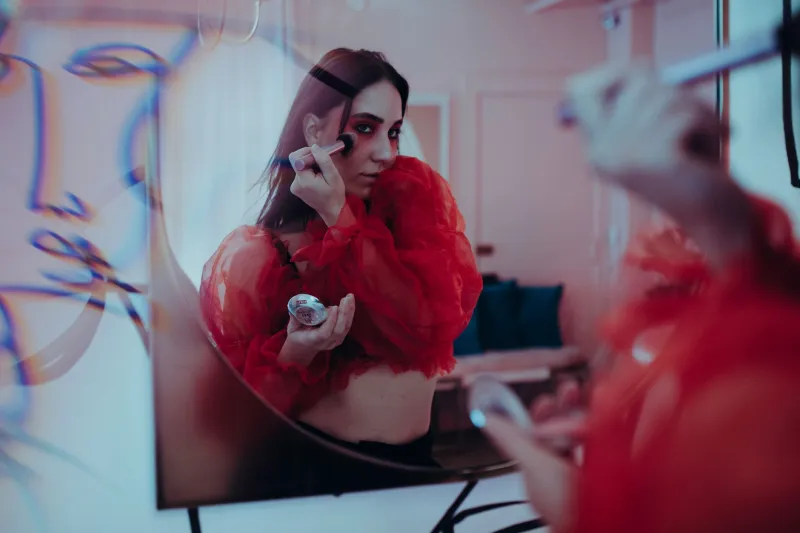
Influencer content has made this roughly one thousand times worse, because now we're not just comparing ourselves to professional shoots — we're comparing ourselves to people standing in their own living rooms with a Ring Light, a beauty filter set to "smoothing: aggressive," and a front-facing camera that has been specifically optimized to make skin look like it's glowing from within. The bronzer in those videos isn't doing the heavy lifting. The app is.
You, however, are not an app. You are a person who has to go to brunch.
The Texture Trap
Bronzers come in approximately nine hundred formulations, and somehow most of them are wrong for most people most of the time.
Matte bronzers, when applied with any enthusiasm whatsoever, create what dermatologists might clinically describe as "a brown situation." There's no warmth, no dimension — just a flat, chalky shadow that reads as dirt in natural light and a bruise under office lighting. Shimmer bronzers, meanwhile, are extremely fun to swatch on your hand in Sephora and absolutely unhinged on an adult face at 11 a.m. on a Tuesday. You will look like you've been lightly bedazzled.
The sweet spot — a satin or low-shimmer formula that mimics the way sun actually hits skin — exists, but the beauty industry buries it between the blinding disco ball compact and the matte powder that was last updated in 2009. Finding it requires the kind of research energy most of us reserve for refinancing a mortgage.
Real Lighting Is Not Your Friend (But It Could Be)
The real villain in the Bronzer Paradox isn't the product. It's the fact that we're applying it in conditions that bear zero resemblance to the conditions we'll actually be standing in.
Ring lights eliminate shadows. Natural light creates them. Most bathroom lighting does something genuinely unspeakable to pigment perception. The bronzer that looks perfectly blended at your vanity will reveal itself, in the harsh light of a Target parking lot, to have the blending radius of a kindergarten art project.
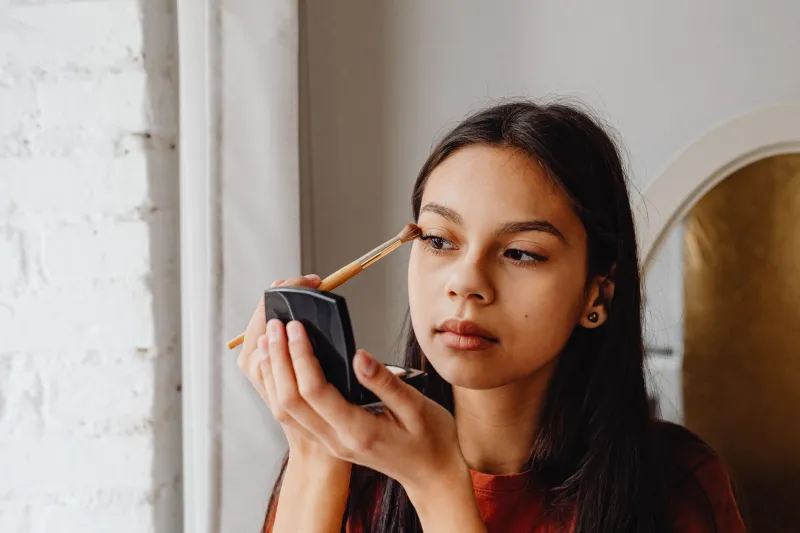
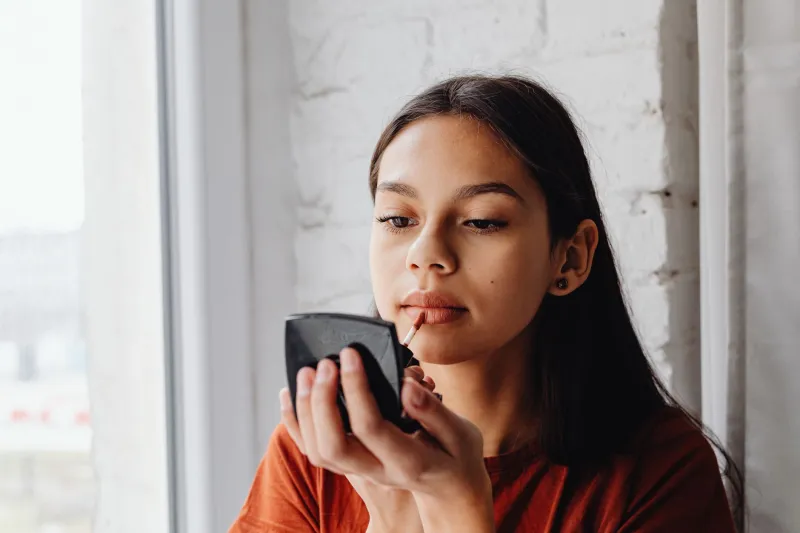
The fix — and this is going to sound annoyingly simple — is to apply bronzer near a window. Not in direct sunlight, because that's a different kind of chaos, but in the diffused natural light that comes through a window on a normal day. It's the closest approximation to the world you'll actually be inhabiting. Suddenly you'll notice exactly where the product is sitting heavy, where it needs blending, and where you've accidentally bronzed your ear.
The Placement Problem
Every tutorial will tell you to apply bronzer where the sun would naturally hit your face: forehead, nose, cheeks, chin. This advice is correct and also completely useless without the follow-up information that the sun, as it turns out, hits your face softly, with a light hand, and does not deposit a full pan of product in one concentrated zone.
The three-swirl technique — where you make a "3" shape from your forehead down to your cheek and jaw — works in theory and in video thumbnails. In practice, it requires a brush the size of a dinner plate and the blending stamina of a professional. Most of us are working with a medium-sized fluffy brush and approximately forty-five seconds before we have to leave the house.
The actual move: use less product than you think, apply it higher on the temples than feels natural, and blend downward with whatever energy you have left after doing everything else to your face. Then step back, look at yourself from six feet away, and ask honestly: do I look warm, or do I look like I've been slow-roasted?
Tips That Actually Work (We Know, We're Surprised Too)
Go one shade lighter than your instinct. The product will build. It always builds. Start where you think you should finish and you'll end up somewhere significantly beyond that.
Buff, don't swipe. Swiping bronzer across your cheek like you're painting a fence is how you end up with a stripe. Buffing in small circular motions distributes the product and, crucially, makes you feel like you know what you're doing.
Check your neck. Not to match it — that's a different argument — but to make sure the two of you are still on speaking terms. A soft dusting of bronzer down the neck and onto the décolletage keeps your face from looking like it belongs to a different body.
Powder first if you're oily. Bronzer applied to a shiny surface will migrate, oxidize, and end up in places you did not intend. A light layer of translucent powder gives it somewhere to live.
Daylight check before you leave. Walk to a window. Take a photo without a filter. If the photo makes you wince, blend more. If it makes you happy, go live your life.
The Actual Goal
The point of bronzer — the original, pre-influencer, pre-editorial-makeup point — was to look like you'd been outside recently. Not like you'd been outside for six months straight without sunscreen, but like you'd had a nice weekend. A little color. A little warmth. The suggestion of vitamin D.
That goal is achievable. It just requires ignoring most of what the internet tells you, using approximately one-third of the product you think you need, and accepting that your face exists in three dimensions under real lighting conditions that no filter has yet successfully conquered.
You are not a camera sensor. You are not an Instagram grid. You are a person with a face, standing in actual sunlight, trying to look like you've been in slightly more sunlight than you have. That's all bronzer ever needed to do.
Don't let it do more.