Retinol and I Are in a Complicated Relationship (It Burns, I Beg, We Both Pretend It's Fine)
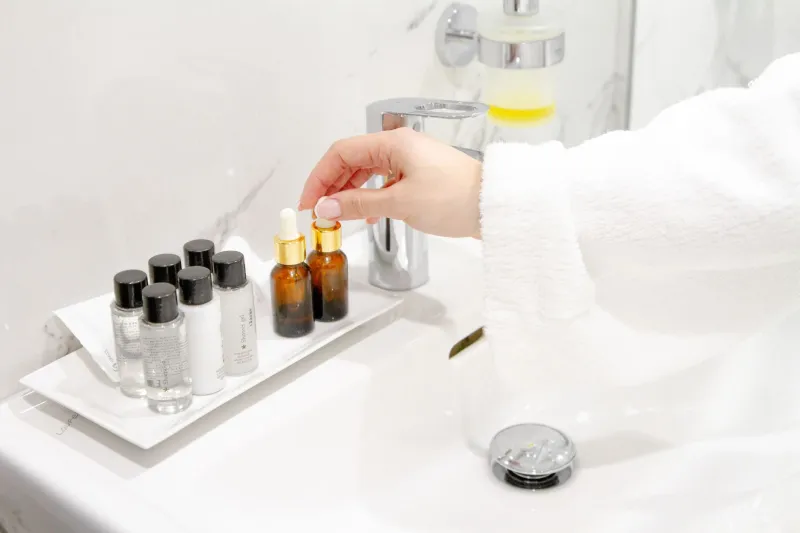
Let me paint you a picture. It's 11 p.m. You're standing in your bathroom, face hovering two inches from the mirror, scrutinizing what can only be described as a crime scene. Your cheeks are peeling. Your chin is a flaky, irritated disaster. Your forehead has staged a full revolt. And yet — and yet — somewhere deep in your brain, a beauty influencer's voice whispers: This is the purge. This means it's working.
This is the retinol experience. Welcome. There is no refund.
Retinol has occupied a uniquely powerful corner of the skincare universe for decades. Unlike most ingredients that ride a trend cycle and quietly disappear (RIP, snail mucin discourse), retinol keeps its throne because it actually has peer-reviewed science behind it. Dermatologists genuinely recommend it. Studies confirm it. It is, by most credible accounts, one of the few topical ingredients that demonstrably improves skin texture, reduces fine lines, and accelerates cell turnover. This is not in dispute.
What is in dispute is everything the beauty industry has done to it since.
How a Legitimate Ingredient Became a Luxury Hostage
Retinol is a derivative of vitamin A. It has existed in dermatology since the 1970s. The original prescription-strength version — tretinoin — is still available as a generic for somewhere in the range of $20 to $40 with a prescription. It is, by most dermatologists' accounts, the gold standard.
So naturally, the beauty industry's response was to create an entirely parallel ecosystem of over-the-counter retinol products ranging from $12 to $350, slap words like encapsulated, bio-retinol, and retinaldehyde on the packaging, and let the consumer sort it out.
Dr. Priya Nanda, a board-certified dermatologist practicing in Chicago, put it bluntly when we spoke with her: "The core science is solid. Retinoids work. But what you're often paying for at the luxury tier isn't necessarily better outcomes — it's better texture, better packaging, and a more comfortable user experience. Which matters! But it's not magic."
Better texture. More comfortable. Got it. So we're paying $180 for the version that doesn't make us want to cry. Noted.
The Purge Phase: Skincare's Most Successful Psychological Operation
If you have ever started a retinol and then Googled your symptoms at 1 a.m., you have encountered the purge phase narrative. It goes like this: your skin will get worse before it gets better. Breakouts, peeling, redness, and general facial chaos are all signs that the retinol is doing something. Pushing impurities to the surface. Accelerating turnover. Working.
This is partially true and almost entirely exploited.
Yes, retinol causes cell turnover, which can temporarily surface congestion. Yes, some initial irritation is normal as skin adjusts. But the beauty industry has taken this legitimate biological footnote and transformed it into a permission slip for suffering. Stick it out, the marketing implies. Your skin is just purging. This is growth. This is the process.
Dr. Marcus Webb, a dermatologist based in Atlanta, told us something that felt almost radical: "If a retinol is causing significant irritation, peeling, or persistent redness after the first few weeks, that's usually a sign the concentration is too high or you're using it too frequently — not a sign it's working exceptionally well. A good retinol regimen shouldn't feel like punishment."
And yet here we all are, praising our own suffering like we've completed a spiritual retreat. The purge phase narrative is, at minimum, overused. At maximum, it's a remarkably effective way to ensure that people who are experiencing a bad product reaction keep using the bad product.
We Tested Five Retinols So Your Face Doesn't Have To
Over eight weeks, our editors rotated through five retinol products at wildly different price points, using each on alternate nights with a consistent base routine (gentle cleanser, moisturizer, SPF in the morning — we're not animals).
The $11 Option (RoC Retinol Correxion, drugstore): Mild, well-tolerated, and quietly effective. Texture improved noticeably by week six. Zero drama. Honestly kind of boring, which in skincare is a compliment.
The $28 Mid-Range (Neutrogena Rapid Wrinkle Repair Serum): Faster-acting and slightly more irritating than the RoC, but nothing unmanageable. Solid results. The kind of product that would be considered a luxury item if it came in a matte black bottle.
The $72 Prestige Option (Sunday Riley A+ High-Dose Retinoid Serum): Genuinely pleasant texture. Some noticeable improvement in skin tone. Also genuinely $72, which means it had better be doing something transcendent. It was doing something. It was not transcendent.
The $130 Serum (SkinCeuticals Retinol 0.5): Clinical packaging, clinical results. Effective and irritating in roughly equal measure during the first two weeks, then settled down. A fine product. A $130 fine product.
The $185 Cream (Augustinus Bader The Cream with TFC8): It contains retinol. It also contains a proprietary complex that the brand's marketing describes in terms usually reserved for NASA press releases. Skin felt good. Skin would probably feel good with the $11 option too. The packaging is very nice.
The honest summary: the drugstore options performed comparably to the luxury options over eight weeks. The luxury options had better sensory experiences — richer textures, more sophisticated formulas, less initial irritation in some cases. Whether that gap justifies a $170 price difference is a question only your bank account can answer.
So What Are You Actually Paying For?
Here's where it gets genuinely interesting. The beauty industry's retinol premium isn't entirely a scam — it's a comfort tax. Higher-end retinols often use encapsulation technology that releases the ingredient slowly, reducing irritation. They pair it with soothing ingredients, elegant emollients, and stabilizing systems that make the experience more tolerable. That has real value if it means you'll actually use the product consistently instead of abandoning it after two weeks of peeling.
But the results — the actual skin changes — are largely driven by the retinol concentration and your skin's tolerance, not the gold-foil packaging or the founder's origin story.
Dr. Nanda's advice was refreshingly practical: "Start low, go slow, and if you can get a tretinoin prescription from a dermatologist, that's still going to outperform most OTC options regardless of price. The best retinol is the one you'll actually use consistently."
The one you'll actually use consistently. Not the one that costs the most. Not the one that punishes you into believing it's working. The one that fits your skin, your routine, and ideally your budget.
The Verdict
Retinol is real. The science is real. The results, used correctly over time, are real. None of that is in question.
What's also real: a beauty industry that took a well-documented dermatological tool, attached aspirational pricing to it, invented a suffering narrative to explain away bad reactions, and convinced an entire generation of skincare enthusiasts that the more it hurts, the harder it's working.
You can have genuinely effective retinol for $11. You can also have a very pleasant, beautifully packaged, slightly more comfortable retinol experience for $185. Both are valid choices. Only one of them requires you to pretend the burning is a feature.
Your skin doesn't know the difference between a luxury serum and a drugstore bottle. It only knows whether you're using it consistently and giving it time to work. Which, honestly, is the most anti-climactic ending to the most dramatic skincare relationship you've ever been in.