You Will Never Use Chartreuse: A Reckoning With the 35-Pan Palette Sitting in Your Drawer
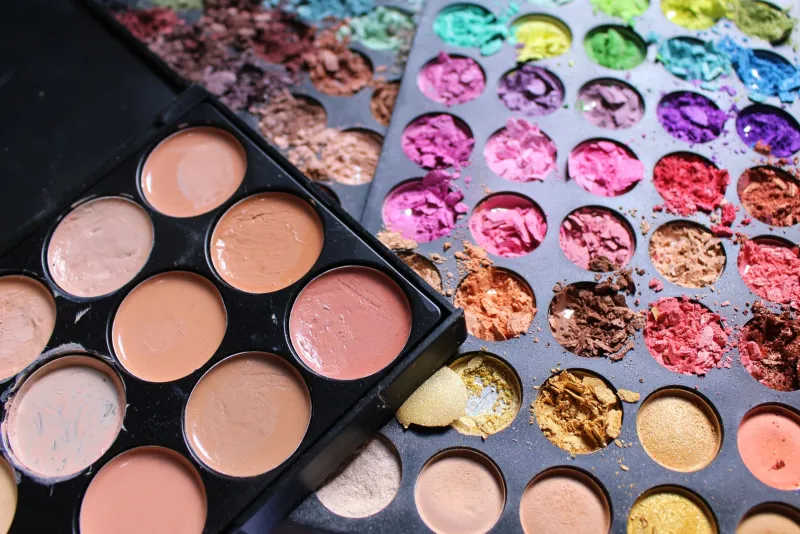
Open your makeup drawer. Go ahead. Now count the eyeshadow palettes. Now count how many shadows in those palettes still have their original pressed texture, completely untouched, a pristine little disc of pigment that has never once seen a brush. We'll wait.
If you're anything like the average American beauty consumer — and the $62 billion cosmetics market suggests you probably are — you own somewhere between four and eleven palettes, each containing anywhere from nine to forty shades, and you rotate through approximately three of them with the loyalty of a golden retriever. The rest are what we in the business call "aspirational inventory." Or, to use the clinical term: stuff you bought because of a YouTube video at 11 p.m. and have touched exactly once.
This is the Eyeshadow Palette Industrial Complex. And it has been running a very successful operation inside your vanity for years.
The Architecture of the Con
Here's the thing about a 35-pan palette: it is not designed for your eyes. It is designed for a photograph. Those gorgeous, color-coordinated flats you see on Instagram — the burnt oranges bleeding into champagne golds bleeding into a single, inexplicable teal — are engineered to look extraordinary in a flat lay and to make you feel, in the three seconds you are scrolling, that your life is incomplete without them.
Beauty brands know something that takes most of us years to admit: the purchase of a palette and the use of a palette are two entirely different events, often separated by a period of months and, in many cases, by the heat death of the universe.
"The palette format is brilliant from a business standpoint," says New York-based makeup artist Dana Kessler, who has worked in editorial and film for over a decade. "You're essentially selling someone thirty-five products at a per-unit price that feels like a bargain, and statistically, they'll only ever develop a relationship with maybe four of them. The rest just sit there looking pretty and making the buyer feel like they have options."
Options. That's the word. We are paying a premium — and these palettes run anywhere from $29 for a drugstore behemoth to $85 for a prestige brand that includes a mirror and a brush you will also never use — for the feeling of optionality. The actual act of applying a vivid cobalt to our lids on a Tuesday morning? That is not part of the plan.
The Sunk Cost Situation Nobody Wants to Talk About
Once you've spent $68 on a palette, something interesting happens in your brain. You don't throw it away. You can't. Because you spent $68 on it. So it stays. It takes up real estate. It occasionally catches your eye and you think, "Maybe today is the day I try the burnt sienna," and then you do your usual taupe-and-brown combo and put it back.
This is the sunk cost fallacy doing what it does best: keeping you emotionally tethered to a purchase that is no longer serving you, on the off chance that someday, somehow, the circumstances of your life will align with the vibe of a smoky jewel-toned editorial look.
Psychologists call this "loss aversion." We at BeautyFool call it "why there are six palettes in a Ziploc bag under your bathroom sink right now."
Makeup artist and educator Priya Nair, who runs tutorials for working makeup professionals in Los Angeles, puts it bluntly: "My kit has maybe twelve shadows I actually reach for. Twelve. The entire industry has convinced regular people that they need thirty-five colors to do a daytime eye. They don't. They need four. Maybe five if they're feeling theatrical."
The FOMO Architecture Is Load-Bearing
Let's talk about limited edition, because nothing has done more damage to our collective financial wellbeing than the words "while supplies last."
Holiday palettes. Collaboration palettes. The palette that dropped because a celebrity mentioned a color once in an interview. The palette that sold out in forty minutes and then reappeared on Mercari for three times the retail price and you almost bought it.
The scarcity model isn't new — luxury goods have used it forever — but beauty brands have applied it to a product category where, genuinely, the stakes could not be lower. You do not need the holiday palette. Nobody has ever arrived at a Thanksgiving dinner and thought, "I wish I'd had access to a limited-edition burgundy palette for this look." And yet. And yet.
"The FOMO mechanism is real and it's specifically calibrated," says consumer behavior researcher and self-described "reluctant beauty addict" Tara Flemming, who wrote her graduate thesis on purchasing patterns in the cosmetics industry. "Brands create urgency because urgency bypasses deliberate decision-making. You're not thinking 'do I need this?' You're thinking 'will I regret not getting this?' Those are very different questions with very different answers."
The answer to the first question, by the way, is almost always no. You do not need the palette. You have the palette. You have several.
What Actually Works (According to People Who Do This for a Living)
We asked three professional makeup artists — the kind who are paid actual money to make actual faces look good under actual lights — what they'd recommend to someone trying to build a functional eyeshadow situation without losing their mind or their savings.
The consensus was humbling in its simplicity.
"A warm neutral palette, a cool neutral palette, and one fun one for when you're feeling yourself," says Kessler. "That's it. You don't need forty shades. You need good formulas and a brush that works."
Nair agrees, adding that the palettes she reaches for most often are the smaller ones — eight to twelve pans — because "every shade is there for a reason. Nobody designing a twelve-pan palette includes a shade they don't believe in. A thirty-five-pan palette? At least eight of those are filler. They had to fill the tray."
This is perhaps the most clarifying thing anyone has ever said to us about eyeshadow: somebody, somewhere, designed that tray, and they needed to fill it, and sometimes the shade that fills the gap is a perfectly decent taupe and sometimes it is a color the Pantone people would describe as "Swamp Situation."
The Verdict (Such As It Is)
Here's what we're not going to tell you: to stop buying palettes. That would be hypocritical, deeply unrealistic, and also we just saw a new one that has the most beautiful dusty rose and we're already weakening.
What we will tell you is this: the next time you're standing in Ulta holding a 28-pan palette that costs $74 and contains three shades you'd actually wear, two you'd wear if the occasion ever arose, and twenty-three that exist purely to make the thing look impressive in the display — you are allowed to put it down. You are allowed to buy the small one. You are allowed to remember that you have approximately nine palettes at home, at least four of which still have intact pans in shades that are technically chartreuse.
You do not need the chartreuse. You know this. The chartreuse knows this.
And yet the palette industrial complex will be here next season with a new colorway, a new influencer partnership, and a very compelling flat lay. We'll see you in the checkout line.


